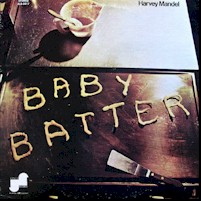
Harvey Mandel
Band members Related acts
|
line-up 1 (1968) - Harvey Mandell -- guitar
supporting musicians: (1968) - Kenny Buttrey -- drums, percussion - Nick De Caro - piano - Carter C.C. Collins - conga - Peter Drake -- steel guitar - Larry Easter - tenor sax - Barry Goldberg - organ, electric piano - Catherine Gotthofer - harp - Eddie Hoh -- drums, percussion - Bob Jones - rhythm guitar - Chip Martin -- rhythm guitar - Jacqueline May Allen -- vocals (soprano) - Steve Miller - organ, piano - Bob Moore -- bass - Charlie Musselwhite - harp - Armando Peraza - conga - Hargus Robbins -- piano - Art Stavro -- bass - Julia Tillman Waters -- vocals - Carolyn Willis -- backing vocals - Edna Wright - backing vocals
- Colin Bailey -- drums - Big Black -- percussion - Sandra Crouch -- tambourine - Paul Lagos (RIP) - - drums - Mike Melvoin (RIP) -- keyboards - Joe Picaro -- percussion - Jeff Porcaro -- percussion - Emil Richards (RIP) -- percussion - Larry Taylor (RIP) -- bass - Howard Wales -- keyboards
|
- Acme Thunder - Canned Heat (Harvey Mandel) - Chicago Blues Reunion - Flying Bear Medicine Show - The Barry Goldberg Blues Band - The Barry Goldberg Reunion - John Mayall - Charley Musselwhite's Southside Band - Nightfire - Pure Food and Drug Act (Harvey Mandel)
|
|
Genre: soul-jazz, rock Rating: **** (4 stars) Title: Cristo Redentor Company: Philips Catalog: PHS 600-281 Year: 1968 Country/State: Detroit, Michigan Grade (cover/record): VG+/VG+ Comments: minor edge wear Available: 1 Catalog ID: -- Price: $40.00
|
Guitarist Harvey
Mandel cut his teeth on the Chicago blues scene, supporting and recording
with the likes of Charley Musselwhite. By the mid-'60s he'd relocated
to San Francisco where he became a regular on the city's club scene.
One of his biggest proponent's was local disc jockey/producer Abe
"Voco" Kesh who helped Mandel score a contract with Philips
Records. Kesh went on to produce Mandel's 1968 debut "Cristo
Redentor" (Spanish for "Christ the
Redeemer"). N
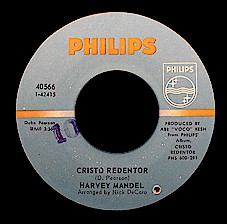
"Christo Rendentor" track listing: (side 1) 1.) Cristo Redentor (instrumental) (Duke Pearson) - 3:45 rating: **** stars Playing this for the first time and hearing the title track I remember wondering what I had stumbled into. Jazz pianist Duke Pearson wrote and arranged "Cristo Rendentor" while working in Donald Byrd's band. It originally appeared on Byrd's 1964 "A New Perspective" album. Not sure if it's true, but Pearson supposedly claimed the song's inspiration came to him while touring Brazil in the early-'60s with jazz great Nancy Wilson. Mandel's arrangement opened with some jazzy orchestration from Nick De Caro. Soprano Jacqueline May Allen, with support from Julia Tillman Waters, Carolyn Willis and Edna Wright then took over the spotlight with their wordless vocals. The results were simply ethereal. The only thing really missing was Mandel's guitar. Mandel played on the song, but his contributions were muted and restrained amidst everything else going on. The song didn't suffer it all from his decision to step back from the spotlight It was certainly an adventuresome choice as the album's debut single:
- 1968's "Cristo Redentor" (instrumental) b/w "Bradley's Barn" (instrumental) (Philips catalog number 40566)
By coincidence I happen to own a copy of Byrd's "A New Perspective" album. (I actually bought it for Neil Miles dazzling cover.) I went back and listened to Byrd's version of the song. The wordless vocals on the original reflect a much more Gospel-influenced flavor with Byrd's mournful trumpet taking the spotlight. 2.) Before Six (instrumental) (Larry Frazier) - 6:25 rating: **** stars The liner notes credited jazz guitarist Larry Frazier with penning "Before Six" but should have also acknowledged the late Curtis Mayfield ads co-writer. Frazer's original version was released in 1962 as a non-LP 45 "B" side. It offered up an enjoyable slice of soul-jazz. Not sure where he heard it, but Mandel apparently included the song in his live set for years. Bless Mandel's soul for sticking close to the original arrangement, yet finding space to demonstrate his mastery or sustain technique. Percussionist Carter Collins added lovely bossa nova undertones. 3.) The Lark (instrumental) (Harvey Mandel - Abe Kesh) - 4:39 rating: *** stars Powered by former boss Charlie Musselwhite on harmonica, "The Lark" was the track the most clearly underscored Mandel's blues roots. The performance was likely to please his hardcore blues fans as well as train fanatics. To my ears it was the album's first disappointment, though I'll admit the sound effects and stereo channeling were pretty cool on a good stereo, or pair of quality headphones. 4.) Snake (instrumental) (Harvey Mandel) - 3:45 rating: **** stars The title serving as a nod to Mandel's nickname, anyone curious to hear his legendary guitar tone should listen to "Snake". Slinky and seductive, that tone, sustain and economical use of effects was on full display on this track which effortlessly shifted from Stax styled soul to hard-rock moves. One of the album's hidden gems. 5.) Long Wait (instrumental) (Harvey Mandel - Barry Goldberg) - 2:48 rating: *** stars Built on a nifty Mandel riff and another appearance by Musselwhite, "Long Wait" sported one of the record's prettier melodies.
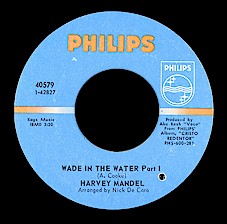
(side 2) 1.) Wade In the Water (instrumental) (James W. Alexander - Sam Cooke) - 7:48 rating: **** stars Best known for Ramsey Lewis' cover, opening up with a string backed soul-jazz vibe, "Wade In the Water" came alive when Mandel's fuzz guitar kicked in. From there you got a good chance to hear how melodic his playing could be. Even the backwards guitar section was impressive. With backing from the late Armando Peraza on percussion and Steve Miller on keyboards I've always been surprised at how funky Mandel's arrangement was - kind of an Isaac Hayes groove with the string arrangement adding a lysergic tinge. Easy to see where Philips was coming from when they decided to release if as a single:
- 1968's "Wade In the Water" (Part I) b/w "Wade In the Water" (Part II) (Philips catalog number 40579)
Filmed in April 2013 by a fan at BB King's New York City, YouTube has a clip of Mandel and his touring band turning in an extended version of the tune: HARVEY MANDEL -- "WADE IN THE WATER"
2.) Lights Out (instrumental) (Harvey Mandel) - 4:48 rating: **** stars Normally I don't think much of heavy orchestral backing, but here Nick DeCaro's arrangement makes the instrumental "Lights Out" even better. Weird, but this one sounded like it could have been written for one of those early-'70 blaxploitation movie soundtracks. 3.) Bradley's Barn (instrumental) (Harvey Mandel) - 3:17 rating: *** stars Funny the last album I listened to was The Beau Brummels' "Bradley's Barn". And while this track was recorded at Owen Bradley's studio with many of the same studio musicians who graced The Beau Brummels album, you weren't going to hear a slice of country-rock, rather the song captured Mandel trotting out some of his hardest hitting lead guitar moves - wah wah, fuzz and other effects. The song also appeared as the "B" side on the "Cristo Redentor" 45. 4.) You Can't Tell Me (instrumental) (Harvey Mandel - Dino Valentino) - 4:20 rating: *** stars One of the breezier performances, "You Can't Tell Me" incorporated a series of time changes, what sounded like twin lead guitars (or maybe it was Mandel double tracking himself) and some tasty Pete Drake pedal steel guitar in the mix. 5.) Nashville 1 A.M. (instrumental) (Harvey Mandel - Abe Kesh) - 3:39 rating: *** stars Based on the title I'm guessing "Nashville 1 A.M" was another tune recorded in Tennessee. Once again Pete Drake added pedal steel to the mix.
© Scott R. Blackerby February 2026
|
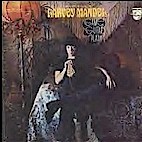
Genre: blues-rock Rating: *** (3 stars) Title: Games Guitars Play Company: Philips Catalog: PHS 600-325 Year: 1969 Country/State:Detroit, Michigan Grade (cover/record): VG/VG Comments: minor ring wear Available: SOLD Catalog ID: SOLD Price: SOLD
|
Like his first two solo albums, 1969's "Games Guitars Play" found Harvey Mandel pursuing a largely blues-rock agenda. Unlike earlier releases, the third LP wasn't an all-instrumental affair. Backed by singer/multi-instrumentalist Russell Dashiel, the decision to go with a more 'commercial' approach proved a mixed blessing. Dashiel's vocals made the set far more diverse than earlier releases. Unfortunately, he wasn't the most appealing vocalist. A capable, but largely anonymous singer, Dashiel sounded more comfortable handling the set's more pop oriented efforts (a cover of Joe South's 'Dry Your Eyes'), whereas the blues-rock stuff just didn't seem to suit him. In contrast, at least to my ears, Mandel's guitar remained the prime selling point - check out his performances on 'Ridin' High' and the funky 'Capurange'. Certainly a mixed success, but worth tracking down ...
"Games Guitars Play" track listing: (side 1) 1.) Leavin' Truck (Sleepy John Estes) - 6:26 2.) Honky Tonk (instrumental) (B. Doggett - S. Shepard - C. Scot - B. Butler) - 3:32 3.) I Don't Need No Doctor (Nicholas Ashford - Valerie Simpson - J. Armstead) 3:45 4.) Dry Your Eyes (Russell Dashell) - 3:03
(side 2) 1.) Ridin' High (instrumental) (Harvey Mandel - Russell Dashiel) - 2:45 2.) Capurange (instrumental) - 6:40 3.) Senor Blues (instrumental) (Horace Silver) - 4.) Games People Play (instrumental) (Joe South) - 4:45
|
|
Genre: blues-rock Rating: *** (3 stars) Title: Get Off In Chicago Company: Ovation Catalog: OVQD/1415 Year: 1971 Country/State: Detroit, Michigan Grade (cover/record): VG+/VG+ Comments: gatefold sleeve; quad compatible pressing; white label promotion copy Available: 1 Catalog ID: 4894 Price: $15.00
|
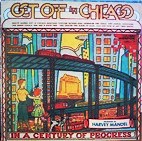
Released by Dick Schory's Ovation label (London Records released the album in the UK), 1971's "Get Off In Chicago" marked Mandel's first stab at self-production. Recorded during a break between tours supporting John Mayall, the album was actually intended as somewhat of a concept piece. To lift a quote right from the liner notes: "He [Mandel] decided to cut an album in Chicago with Chicago musicians. The album would be written and composed spontaneously in the recording studio." Well guess what? That's exactly what you got on this collection ... With backing from a host of Chicago-based musicians including keyboardist Ira Kart, bassist NickTountas, Fat Water vocalist Vickie Hubly ("Jelly Roll") and the rest of Fat Water on the blues-rocker "Highway Blues" you got a collection heavy on Chicago blues numbers. Given Mandel's musical career that choice made perfect sense, if it didn't make for the most exciting venture of the year. Elsewhere Mandel rounded the album out with a couple of jazzy interludes ("Local Days"). It was all quite earnest and professional, occasionally actually generating a little bit of steam (the jazz-funk instrumental "Sweet Lynda"), but simply didn't do too much for my ears.
Always loved John Craig's 1920s-styled album cover:
"Get Off In Chicago" track listing: (side 1) 1.) Jelly Roll (Harvey Mandel - Ira Kart - Freddie Fox - Vickie Hubly) - 3:52 rating: *** stars Musically "Jelly Roll" wasn't any great shakes - kind of a run-of-the-mill blues-rocker. That said, I've always liked the tone Mandel got out of his guitar on this one. The track was also interesting to hear Mandel sharing lead vocals with ex-Fat Water vocalist Vickie Hubly. Credited to "JIve" the song was tapped as a promotional single:
- 1971's "Jelly Roll" b/w "Highway Blues" (Ovation catalog number OV 1026)
2.) High Test Fish Line (Norm Wagner - Ken Little - Ira Kart - Thomas Russ) - 5:19 rating: *** stars Given Mandel's reputation as a guitarist, it was interesting to hear "High Test Fish Line" split the focus between Mandel's guitar and the late Ira Kart's piano. The song was also interesting for introducing a disctinctive jazzy vibe to the mix. 3.) Local Days (Nick Tountas) - 3:34 rating: ** stars Lite cocktail jazz - this one wouldn't have sounded out of place on a '60s Astrud Gilberto album. The song title was actually "Lonely Day" (the label typoed the title). Judy Roberts was featured on the wordless vocals. 4.) Check Me Out (Harvey Mandel - Freddie Fox) - 3:46 rating: *** stars "Check Me Out" offered up a decent mash-up of blues and funk. The track would have benefited from a strong lead singer. 5.) Highway Blues (Harvey Mandel - Dave Cook - Don Cody - G.E. Stinson - Freddie Fox) - 3:09 rating: ** stars Co-written by Mandel and a late-inning version of the Chicago band Fat Water, "HIghway Blues" was a conventional slice of electric blues. Very Canned Heat-styled vibe. he song was also tapped as the "B" side for Mandell's "Jelly Roll" single.
(side 2) 1.) I'm a Lonely Man (Dave Cook) - 6:26 rating: **** stars Written and featuring keyboardist Dave Cook, "I'm a Lonely Man" was easily the album's funkiest and most impressive performances. The song also featured Mandel's standout guitar performance. 2.) Sweet Lynda (Instrumental) (Harvey Mandel) - 3:06 rating: *** stars Jazz-funk? Funk-jazz? Regardless, the instrumental "Sweet Lynda" had a nice groove to it. 3.) Springfield Station Theme (Norm Wagner - Ken Little) - 6:28 rating: *** stars Taunt slice of Chicago blues with Ken Little handling vocals and bass. 4.) Race Track Daddy (Instrumental) (Harvey Mandel) - 5:52 rating: *** stars Another slice of blues-jazz? Jazz-rock? Who know what the right label is. Mandel used the instrumental "Race Track Daddy" to aptly showcase his guitar dexterity.
© Scott R. Blackerby February 2026
|
|
Genre: rock Rating: **** (4 stars) Title: Baby Batter Company: Janus Catalog: JLS-3017 Year: 1971 Country/State: Detroit, Michigan Grade (cover/record): VG+/VG+ Comments: -- Available: 1 Catalog ID: -- Price: $30.00
|
I wasn't prepared for Harvey Mandel's fifth solo album. Based on the other solo albums I'd heard I had just come to associate Mandel with blues-rock. While I've never been a massive blues-rock fan, I've enjoyed Mandel's catalog so when I stumbled across a copy of 1971's "Baby Batter" at a yard sale I grabbed it. Naturally Chicago blues is what I expected to hear. When I actually got around to listening to the album ... What in the world? Geez, did I put on a different artist by mistake? Produced by longtime associate Abe "Vos" Kesh, this all instrumental set found Mandel and compatriots largely tossing out their blues roots in favor of a collection of soul, funk and rock moves. It was hard to accurately describe, them but on the title track and "Midnght Sun" the combination of funky jam tunes and Shorty Rogers' arrangements recalled something Motown's Dennis Coffey might have recorded. To be honest, DJ Dusty Street's liner notes may provide the best description of those performances: "The album is unique among Harey Mandel albums. It can be described only as a "produced" jam. "Produced" because it was done in a studio, but kept the spontaneity of an all-night session that was the jam. The uniqueness comes from the string arrangements of Shorty Rogers on 'Baby Batter' and 'Midnight Sun.' They're used as a mellow bottom (almost like a rhythm guitar) for a mountain of fine music." That wasn't to imply that was the sound across the whole album. "Freedom Ball" and "El Stinger" were more rock oriented tunes showcasing Mandel's tight fuzz and feedback runs. I'm no guitar fanatic but on those performances Mandel's work held up to comparisons with the likes of Jeff Beck (though these tracks were far less jazzy), Rory Gallagher (virtually no blues on this set), or Roy Buchanan (definitely less blues). In fact, with the exception of the bluesy "Morton Grove Mama"and the closer "Hank the Ripper" there were few blues moves on the set. Curiously, to my ears the album's best performance was the Stax-influenced "One Way Street".
Unlike anything else in his catalog and probably the album for the curious to start with.
"Baby Batter" track listing: (side 1) 1.) Baby Batter (instrumental) (Harvey Mandel) - 3:47 rating: **** stars For anyone expecting to hear blues-rock (like me), the title track came as a massive shock. Trading blues for orchestrated funk, about the best analogy I can come up with is a cross between MFSB and Dennis Coffey. This is one of those tracks that makes it hard to sit still. And yes, I'll admit I didn't realize the title was slang for semen. Janus released the track as a single:
- 1971's "Baby Batter" (instrumental) b/w "Midnight Sun" (instrumental) (Janus catalog number J-144) 2.) Midnight Sun (instrumental) (Harvey Mandel) - 6:25 rating: **** stars There are so many talented guitarist out there and Mandel deserves to be on the list, though he is frequently forgotten. I'm not a guitar player so all the technicalities fly over my head, but the tone he got on the slinky "Midnight Sun" was so cool. I bet someone can tell me what effects he used to get that sound. The track was also tapped as the "B" side for Mandel's "Baby Batter" single. 3.) One Way Street (instrumental) (Harvey Mandel) - 4:22 rating: **** stars The instrumental "One Way Street" reminds me of a Stax recording - Imagine Booker T. and the M.G.s with Steve Cropper and Booker T. given the spotlight to showcase their chops. I'm guessing Howard Wales played the Booker T. roll. 4.) Morton Grove Mama (instrumental) (Harvey Mandel) - 4:59 rating: *** stars Splitting the spotlight across Mandel, bassist Larry Taylor and keyboardist Wales, the bluesy "Morton Grove Mama" was more along the lines of what I was expecting to hear from a Mandel solo album. Nothing wrong with Chicago blues, but my ears just don't capture the genre's charms.
(side 2) 1.) Freedom Ball (Harvey Mandel) (instrumental) - 6:25 rating: **** stars I'm not a drummer, but I have to say that the groove on this one was intoxicating. Not sure if it was played by Colin Bailey or Paul Lagos bur it was one of those grooves that I'm sure has been repeatedly sampled. It's also interesting to see how Mandel cozied up to the groove and just took off with it. Yeah he played a few more notes that his usual economic stylings, but wow ... 2.) El Stinger (instrumental) (Harvey Mandel) - 7:27 rating: **** stars Geez, how does Mandel get those sounds out of his guitar ? "El Stinger" was a growling rocker that thanks in part to the extensive percussion, would not have sounded totally out of place on a Santana album. Admittedly this was one of the tracks where he forsaked that economical playing style for a busier attack. 3.).Hank The Ripper (instrumental) (Harvey Mandel) - 5:16 rating: *** stars "Hank the Ripper" ended the album with another bluesy tune, though Mandel's rock inclinations ultimately came through.
© Scott R. Blackerby February 2026
|
BACK TO BADCAT PAYMENT INFORMATION
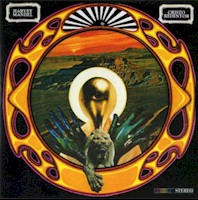
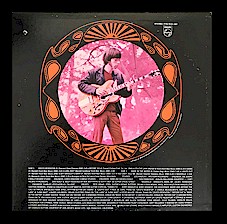 ormally
I'm not a big fan of instrumental albums. Mandel's debut is one of
those exceptions. Reflecting a mixture of Mandel originals and outside
covers, the ten tracks were recorded across sessions at different studios in
Los Angeles and Brad Owens's Memphis studio. In spite of the fractured
recording history the album was uniformly enjoyable. Perhaps the
biggest surprise came in the form of the wide variety of efforts here.
While lots of reviews label this a blues album, with the exception of
"The Lark" Mandel's blues roots were largely absent. And
another word of warning. Just as this isn't a blues collection,
ignoring the album cover, this wasn't the "psych" masterpiece some
reviews would have you believe. Yes, Mandel's unique guitar tone and
versatility were on display throughout the set (check out his cover of
"Before Six"), and there were occasional psych brushes (his fuzz
laden soloing on "Wade
In the Water"), but don't be
expecting to hear an album of mid-'60s San Francisco lysergic tinged
madness. Instead, as displayed by covers of jazz guitarist Larry
Frazer's "Before Six", The Sam Cooke penned "Wade
In the Water", Duke Pearson's title track and the original "Lights
Out" Mandel's focus found him exploring soul-jazz. Nothing
like what I was expecting and all the better for it. Certainly the
best Mandel solo effort I've heard (admittedly there are a lot I haven't
heard).
ormally
I'm not a big fan of instrumental albums. Mandel's debut is one of
those exceptions. Reflecting a mixture of Mandel originals and outside
covers, the ten tracks were recorded across sessions at different studios in
Los Angeles and Brad Owens's Memphis studio. In spite of the fractured
recording history the album was uniformly enjoyable. Perhaps the
biggest surprise came in the form of the wide variety of efforts here.
While lots of reviews label this a blues album, with the exception of
"The Lark" Mandel's blues roots were largely absent. And
another word of warning. Just as this isn't a blues collection,
ignoring the album cover, this wasn't the "psych" masterpiece some
reviews would have you believe. Yes, Mandel's unique guitar tone and
versatility were on display throughout the set (check out his cover of
"Before Six"), and there were occasional psych brushes (his fuzz
laden soloing on "Wade
In the Water"), but don't be
expecting to hear an album of mid-'60s San Francisco lysergic tinged
madness. Instead, as displayed by covers of jazz guitarist Larry
Frazer's "Before Six", The Sam Cooke penned "Wade
In the Water", Duke Pearson's title track and the original "Lights
Out" Mandel's focus found him exploring soul-jazz. Nothing
like what I was expecting and all the better for it. Certainly the
best Mandel solo effort I've heard (admittedly there are a lot I haven't
heard).