Sailor (UK)
Band members Related acts
|
line up 1 (1973-78) - Georg Kajanus (aka Georg Hultgreen) -- vocals, guitar, charango, harp, keyboards, harmonium - Henry Marsh -- nickelodeon, accordion, keyboards, marimbas, backing vocals - Philip Pickett -- nickelodeon, keyboards, guitarron, backing vocals - Grant Serpell -- drums, percussion, backing vocals
line up 1 (1980) NEW - Gavin David -- vocals, guitar (replaced Georg Kajanus) NEW - Virginia David - lead vocals (replaced Georg Kajanus) - Henry Marsh -- nickelodeon, accordion, keyboards, marimbas, backing vocals - Philip Pickett -- nickelodeon, keyboards, guitarron, backing vocals
line up 3 (1989-1995) NEW - Georg Kajanus (aka Georg Hultgreen) -- vocals, guitar, charango, harp - Henry Marsh -- nickelodeon, accordion, keyboards, marimbas, backing vocals - Philip Pickett -- nickelodeon, keyboards, guitarron, backing vocals NEW - Grant Serpell -- drums, percussion, backing vocals
line up 4 (1996-99) NEW - Peter Lincoln -- (replaced George Kajanus) - Henry Marsh -- nickelodeon, accordion, keyboards, marimbas, backing vocals - Philip Pickett -- nickelodeon, keyboards, guitarron, backing vocals - Grant Serpell -- drums, percussion, backing vocals
line up 5 (1999-2001) NEW - Anthony English -- nickelodeon, accordion, keyboards, marimbas, backing vocals (replaced Henry Marsh) - Peter Lincoln -- (replaced George Kajanus) - Philip Pickett -- nickelodeon, keyboards, guitarron, backing vocals - Grant Serpell -- drums, percussion, backing vocals
line up 6 (2001-2005) NEW - Rob Alderton -- nickelodeon, accordion, keyboards, marimbas, backing vocals (replaced Anthony English) - Peter Lincoln -- (replaced George Kajanus) - Philip Pickett -- nickelodeon, keyboards, guitarron, backing vocals - Grant Serpell -- drums, percussion, backing vocals
line up 7 (2005-2006) NEW - Henry Marsh -- nickelodeon, accordion, keyboards, marimbas, backing vocals (replaced Rob Anderton) - Peter Lincoln -- vocals, guitar (replaced George Kajanus) - Philip Pickett -- nickelodeon, keyboards, guitarron, backing vocals - Grant Serpell -- drums, percussion, backing vocals
line up 8 (2006-2009) - Henry Marsh -- nickelodeon, accordion, keyboards, marimbas, backing vocals NEW - Oliver Mash -- vocals, guitar (replaced Peter Lincoln) - Philip Pickett -- nickelodeon, keyboards, guitarron, backing vocals - Grant Serpell -- drums, percussion, backing vocals
line up 9 (2009-2011) - Henry Marsh -- nickelodeon, accordion, keyboards, marimbas, backing vocals NEW- Nick Parvin -- vocals, guitar (replaced Oliver Marsh) - Philip Pickett -- nickelodeon, keyboards, guitarron, backing vocals - Grant Serpell -- drums, percussion, backing vocals
line up 10 (2011-2014) - Henry Marsh -- nickelodeon, accordion, keyboards, marimbas, backing vocals NEW - Oliver Marsh -- vocals, guitar (replaced Nick Parvin) NEW- Thomas Marsh -- drums, percussion (replaced Grant Serpell) - Philip Pickett -- nickelodeon, keyboards, guitarron, backing vocals
|
- And the Mamuks (Georg Kajanus and Henry Marsh) - Affinity (Grant Serpell) - Data (Georg Kajanus and Henry Marsh) - Eclection (Georg Kajanus) - Frontm3n (Peter Lincoln) - Gringo (Henry Marsh) - George Hultgreen (solo efforts) - The Ice (Grant Serpell) - Kanjus-Pickett (Georg Kanjanus and Philip Pickett) - Peter Lincoln (solo efforts) - Noir (Georg Kajanus) - Smokie (Peter Lincoln) - The Sweet (Peter Lincoln) - Toast (Henry Marsh)
|
|
Genre: pop Rating: 3 stars *** Title: Sailor Company: Epic Catalog: EPC
30887 Country/State: Trondheim, Norway, London UK Grade (cover/record): VG+/VG+ Comments: UK pressing Available: 1 Catalog ID: -- Price: $20.00
|
Born in Norway and raised in Paris and and
Montreal, the mid-'60s found Georg Hultgreen (aka Georg Kajanus), living and
working in London. In 196u he was a founding member of the band
Eclection who recorded one album for Jac Holzman's Elektra Records before
breaking up in late 1969. Having written eight of the eleven tracks on
"Eclection", Kajanus turned his attention to studio
work and songwriting, supporting the likes of Cliff Richards whom wh wrote
"Flying Machine" for and Al Stewart (appearing on Stewart's 1970
album "Zero She Flies"). Having met English
songwriter/musician Phil Pickett through music published E H Morris,
in 1970 the pair decided on a musical collaboration. As Kanjus/Pickett
they were signed by the small US Signpost label, releasing an instantly
obscure set of folk-rock (1972's "Hi Ho Silver" -
Signpost catalog number SGA.5001)
The pair subsequently decided to form a band, recruiting ex-Gringo keyboardist Henry Marsh and former Affinity drummer Grant Serpell for what became Sailor. The quartet started rehearsing and recording material in 1973. They also integrated Kajanus' Kajanus's nickelodeon into their sound. A Frankenstein-styled instrument, it combined two pianos, mini organs, glockenspiels and percussion into a single frame. Signed by CBS/Epic, Kanjanus was originally interested in recording a concept album built loosely on a theatre concept his memories of life in Paris' Red Light district,. Serpell and the rest of the band suggested shifting the sound to a more pop direction. Epic demonstrated considerable faith in the band allowing Kanjanus to produce 1974's "Sailor". Hw as also responsible for writing all ten tracks; handling lead vocals and twelve-string guitar.
Penned by Diane Hyatt, the extensive liner notes made it clear how off the mark the American marketing campaign was: "In 1936, "Come to the Cabaret" might have been an invitation to Le Matelot, a small cafe in Paris known for its house-band and the literary luminaries who frequented the cosmopolitan coffee house. On any given night such creative talents as Josephine Baker, Janet Flanners, Chagall or Fitzgerald could be seen talking, boasting or singing at the place Hemingway fondly referred to as "that contagious box of music." During World War II the doors of Le Matelot shut for the first time in many years. The proprietor, M. Faux, a French hero, was left bound and humiliated by the Nazis in front of his cafe for twelve hours to await the morning and his execution. Instead of a German arrival at daybreak, an AWOL American Navy officer appeared and freed the owner. When M. Faux inquired his name he replied, "Call me Sailor, and I'll see you around sometime." The owner never saw him again, but in gratitude he christened his house-band SAILOR. As various members of SAILOR came and went they bore the distinction of contributing to a French musical legacy. In 1971, Le Matelot, the survivor of three and a half decades of lively tradition, closed for the last time. Fire did what a war could not--destroyed a musical and cultural landmark. The band, SAILOR, disappeared until the summer of 1973 when Steve Morris, son of successful music publisher Edwin Morris, discovered Phil Pickett in session work. Steve and Phil embarked on an odyssey, zig zagging continents looking for other former members of SAILOR. After an exhaustive search they found Henry Marsh, Grant Serpell and Georg Kajanus and re-formed the modern incarnation of the original four guys in white suits. Henry, an accomplished keyboard man and accordianist, had been a regular with SAILOR since 1970. Grant, the drummer and the dreamer, had a background in mathematics and engineering, and was influenced by his father, a professor of music at the University of Paris. Under the direction of Georg, son of a Russian prince and "a man who refuses to limit his interests to any single discipline," they designed twin nickelodeons with synthesizers in their mechanisms and created a fresh style and sound. In this, the group's first album, the maritime minstrels speak eloquently of the pique and pleasure of the wayfarer's life. SAILOR is a brash and bawdy excursion in first-class contemporary music. Listen to their compatible harmonies and absorb their every-word-paints-a-picture lyrics. Their performance is truly a moveable feast. If you enjoy discovering new things, listen to SAILOR. Each cut is a slice of life. It's SAILOR's night on the town and rousing good fun. N'est-ce pas?"
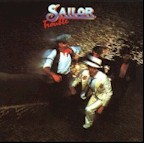
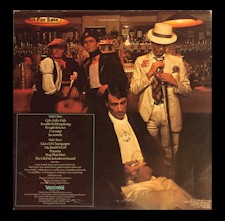
"Trouble" track listing:
1.) Traffic Jam (Georg Kajanus) - 3:24 2.) Blue Desert (Georg Kajanus) - 3:45 3.) Sailor (Georg Kajanus) - 2:57 4.) Girls Of Amsterdam (Georg Kajanus) - 3:08 5.) The Street (Georg Kajanus) - 3:32
(side
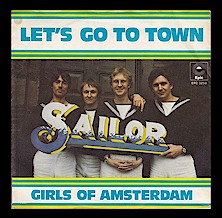
2) Kajanus' "concept" was seldom as clear as on "Let's Go To Town". In spite of the bouncy nickelodeon power melody, the sailors' dreams come true theme wasn't particularly uplifting. The track was released as a Dutch single in 1975.
- 1975's "Let's Go To Town" b/w "Girls Of Amsterdam" (Epic catalog number EPC 3258)
YouTube has several live performances of the song. This one is from a 1975 show on Dutch television where the audience was apparently sedated before the show. Sailor - Let's Go to Town ( Original Footage At The BBC 1975 Rebroadcast 192 TV HQ Audio )
2.) Josephine Baker (Georg Kajanus) - 4:00 3.) Blame It On The Soft Spot (Georg Kajanus) 3:39 4.) Open Up The Door (Georg Kajanus) - 2:30 5.) Sailor's Night On The Town (Georg Kajanus) - 3:24
The group's first UK single was "Traffic Jam" from their first album, Sailor. SAILOR - Girls Girls Girls, A Glass Of Champagne, The Secretary, La Cumbia... The USA liner notes of the 1974 "Sailor" album:
Review by "All Music Guide": The first album by SAILOR dropped onto the U.K. glam scene in late 1974 like the greatest secret you've never been told. Comparable in its underground impact to the first, similarly overlooked albums by Cockney Rebel and Queen a little over a year earlier, SAILOR boasted a spellbinding introductory single, "Traffic Jam," a slew of magical follow-throughs, and the promise of a glittering future that could not have been broadcast any louder. And so it proved - a year on, and SAILOR was everywhere. "Traffic Jam" remains one of the group's finest achievements, an ecologically themed reflection on the history of the motorcar, executed in shamelessly Beach Boys-esque style. "Let's Go to Town" and "Sailor's Night on the Town," meanwhile, conjure visions of a bizarre collision between 10cc and Jacques Brel, poignant pop with a beautifully bittersweet bite. Even "Sailor," certainly the weakest track on the entire album, is vindicated by the atmospheric chorus of foghorns that balances the brittle superficiality of the song itself. It is difficult to play favorites among the first three SAILOR albums - like the other bands to which the group can most readily be compared (add Roxy Music and Sparks to the aforementioned litany), each has a distinct character that is as unique as it is inseparable from the main body of work. However, simply for the joyous rush of "Traffic Jam" and the aching melancholy of "Josephine Baker," SAILOR stands not only as a dynamic introduction to the magic of this band, but also as the yardstick by which the group could not help but measure its own future endeavors. - Dave Thompson
Very underrated album. The music can best described as a mixture of cabaret and pub rock...the harmony vocals are very refreshing ( Beach Boys ) and the nickelodeon sound...is a real trademark. The concept....the (sex) life of sailors brought in very easy to get in sing-a-longs with very clever lyrics ( flying sometimes in the face of some moralists) (Brel) The sex life on the boat seems as interesting as it is on the street. In their heydays the band may be a little commercial ...but I think it's the best...after an half bottle of tequila. Sailor did a very good second album too....but thereafter the ship was slowly sinking. There are no weak tracks on the album ..... it's all fun...and every track could be a potential 'hit' -Josephine Baker...still my favourite This is an example for those who are not familiar with the band :http://fr.youtube.com/watch?v=bNlos-rA7NI&feature=related
Sailor is the debut studio album by British rock group Sailor, released in August 1974 by Epic Records, and produced by Georg Kajanus. Background Production and songs Sailor recorded their debut album on 16 May 1974 at the Studio 2 section of Morgan Studios.[4] The title track "Sailor" features a foghorn sound, replicated by an ARP 2600 synthesiser with echoes and reverbs.[4] "Traffic Jam" was the only song recorded prior to their studio session, as it was part of a demo tape.[5] All of the members of Sailor have expressed acknowledgement of the Beach Boys being influential to their sound in the album, each having owned a copy of Surf's Up on LP.[4] Georg Kajanus intended for the debut album to revolve around prostitutes and sailors, viewing it as a concept album.[4] In a 1974 interview for Record Mirror, Henry Marsh describes the musical content of Kajanus' songs as "polite, not offensive", suggesting that the sailors in the songs are "more loveable" characters than the lyrics suggest.[6] "The Girls of Amsterdam" and "Sailor's Night at the Town" were inspired by Kajanus' recollection of his time at the red light district around Europe and Mexico.[4][3] Release and critical reception Professional ratings Review scores Source Rating The Encyclopedia of Popular Music StarStarStar[7] AllMusic StarStarStarHalf star[1] Sailor was released in August 1974 by Epic Records.[8] With an accompanying single "Traffic Jam", the album was supported by a series of tours, including a scheduled, but later cancelled concert tour with rock band Mott The Hoople, where Sailor was a supporting act,[8][7] and a television appearance on BBC Two's music series In Concert, broadcast on 4 September 1974.[6][9] Their TV appearance attracted the attention of the National Viewers' and Listeners' Association (alluded as the "Whitehouse brigade" by Record Mirror) over the word "flasher", and mentions of automobile brands like Ford Motors and the Volkswagen Beetle in the performed song, "Traffic Jam", which they perceived as advertisement.[6] Despite this, the album and its accompanying singles had a favourable and welcoming reception. CashBox remarked favourably that in "Traffic Jam", Sailor showed "tremendous poise" with its "lighthearted happy sound and an infectious beat which could take it all the way to the top".[10] Sounds noted that the reception was enthusiastic in countries like the Netherlands, and described Sailor's music as "idiosyncratic", remarking that they hoped "British audiences will respond to them as open-mindedly as the Dutch did".[8] Alan Francis, writing for Record Mirror, was favourable to the "faultless harmonies" of "Josephine Baker" and "Traffic Jam" in one of their live performances supporting the debut album, stating that Sailor encompassed a mix of "folk, rock, and pop" but did not have a "cluttered sound".[2] Writing for AllMusic, Dave Thompson compared Sailor's music style in the debut album to The Beach Boys, 10cc, and Jacques Brel and named "Traffic Jam", "Let's Go to Town", and "Josephine Baker" as exemplary songs that fully reflects the "magic of this band".[1] Music writer Colin Larkin gave the album three stars out of five stars.[7] Reviewing for the Cherry Red Records boxed set Sailor: The Albums 1974-78 including a reissue of Sailor, Kevin Rathert in It's Psychedelic Baby! Magazine noted the vocal harmonies in Sailor and described the album as a mix of "light hearted, red light district folk tunes" and "excellent cabaret style tunes" that makes for a "pleasant listen". The first album by Sailor dropped onto the U.K. glam scene in late 1974 like the greatest secret you've never been told. Comparable in its underground impact to the first, similarly overlooked albums by Cockney Rebel and Queen a little over a year earlier, Sailor boasted a spellbinding introductory single, "Traffic Jam," a slew of magical follow-throughs, and the promise of a glittering future that could not have been broadcast any louder. And so it proved -- a year on, and Sailor was everywhere. "Traffic Jam" remains one of the group's finest achievements, an ecologically themed reflection on the history of the motorcar, executed in shamelessly Beach Boys-esque style. "Let's Go to Town" and "Sailor's Night on the Town," meanwhile, conjure visions of a bizarre collision between 10cc and Jacques Brel, poignant pop with a beautifully bittersweet bite. Even "Sailor," certainly the weakest track on the entire album, is vindicated by the atmospheric chorus of foghorns that balances the brittle superficiality of the song itself. It is difficult to play favorites among the first three Sailor albums -- like the other bands to which the group can most readily be compared (add Roxy Music and Sparks to the aforementioned litany), each has a distinct character that is as unique as it is inseparable from the main body of work. However, simply for the joyous rush of "Traffic Jam" and the aching melancholy of "Josephine Baker," Sailor stands not only as a dynamic introduction to the magic of this band, but also as the yardstick by which the group could not help but measure its own future endeavors. Formed in 1973 by Norwegian-born multi-instrumentalist/vocalist/songwriter Georg Kajanus, the original configuration of Sailor comprised Kajanus and three Brits, guitarist/vocalist Henry Marsh, bassist Phil Pickett and drummer Grant Serpell. The two guitar, bass and drum configuration was short lived however. When Kajanus came to the others with something he was in the midst of creating, a kind of musical revue, “Sailor’s Night On The Town” which included harmoniums, mandolins, glockenspiels, hand-bass drums and tack pianos, the members agreed that having coming from the 1960s when in their minds there were many bands all basically doing the same thing, Kajanus’ tune was something totally unique, and indeed was the sound they had been looking for. Thus began the musical adventures of an incredibly original and interesting pop band, which released a total of five albums and a whopping fourteen singles on the Epic label between 1974 and 1978. The fruits of Sailor’s efforts during this period have been compiled by Cherry Red Records and released on the five disc, fifty nine track box set issued on their 7t’s imprint and reviewed here. Sailor had an incredibly unique sound, the result of their unconventionally exotic usage of instruments including charango, Veracruzana harp, harmonium, accordion, piano, marimbas, synthesised brass and reed, synthesiser, guitarron, synthesised strings, calliope, xylophone, bass, autoharp and cruz bass in addition to more conventional instruments such as 12-string guitars, acoustic guitars, piano, mandolin, Hammond organ and drums. To top things off Kajanus invented an instrument called the Nickelodeon, consisting of two upright pianos, two synthesizers, mini organs and a glockenspiel, all mechanically linked within a wooden frame, stained to resemble some strange piece of antique furniture. The upright pianos were fixed back to back, Pickett playing the bass side, Marsh the treble. This allowed the band of four to deliver the sound of all the instruments used in the studio, and coming well before the invention of the midi keyboard that can produce any number of sounds at the touch of a button. Sailor’s stage act included a harbour town backdrop, cafe and a street lamp which cast a red glow over the players whose repertoire consisted of songs about red-light districts, sleazy underworld characters and romance of an altogether quirky nature delivered by the neatly dressed, short-haired quartet. The overall ambience somewhat resembled that of a strange combo from the 1940s. Sailor’s 1974 self-titled debut album is a delightful mix of light hearted, red light district folk tunes such as “Blue Desert” “Josephine Baker” “Sailor’s Night On The Town” and “The Girls Of Amsterdam” with its nod toward the ladies of the night in the nation where the group was to enjoy its greatest success, with the album containing no less than four Top Five hits there. One of them, the gorgeous acoustic, vocal harmony filled “Traffic Jam” was selected by Epic Records to be the band’s first UK single as well as the opening track for the album. Unfortunately the tune did not draw the attention at home that it did in the Netherlands. “Sailor” also includes some excellent cabaret style tunes, “The Street” “Blame It On The Soft Spot” to name but two. The album’s ten tracks are joined by three bonus cuts, the 7” version of “Blue Desert” as well as the non-LP a-side “Sailor” and non-album b-side “Harbour.” With its light, breezy and sometimes even zany acoustic sound the album is a most pleasant listen and certainly deserved a better fate in the sales department. After extensive touring the band entered the studio to record their follow up 1975 LP “Trouble” produced by Rupert Holmes and considered by many the group’s finest hour. Among the album’s tracks are their two biggest selling UK singles, the sprite, red-light number “Girls, Girls, Girls”with its catchy pop hook and the bouncy cabaret tune “A Glass Of Champagne” filled with tasty pianos and loads of commercial appeal. Both tunes hit the Top Ten in the UK, the former reaching #7, while the latter climbed all the way to #2. Unfortunately, and definitely not due to inferior material, Sailor would enjoy only one more UK Top Forty hit during their Epic years.”Trouble” did include other cabaret flavored delights such as “Coconut” whose title is reminiscent of producer Holmes’ hit “The Pina Colada Song” which made the US Top 10 in 1979, “People In Love” and “Stop That Man.” The group’s versatility shines through on the acoustic instrumental “Jacaranda” and the balladish “My Kind Of Girl.” Despite the hit singles, “Trouble” was not a great commercial success in the UK although it is a most entertaining and enjoyable listen and did perform well in the Netherlands.. SAILOR /Aylesbury. "I KNOW every band .eyes they are unique, but we really are." Last weekend's Sailor gig at Aylesbury dispelled any doubts about the validity of this statement. Going to see their validity Is itself quite like slatting a woman of disrepute. One pays one's money, receive, highly satisfactory service in return, and goes back home refreshed and relaxed. The reason for drawing this rather dubious parallel la not quite as obscure as you might imagine. Sailor have an obsession with and nd all things Parlslenne. Particularly of Interest to them are a strange profession of wane'n who operate in what Is more commonly known as the red light district. Songs like Pimps Brigade, Sailor's Night On The Town and Girls Of Amsterdam, are not en much obscene as taste. fully ti Wadng. Musically they never put a foot wrong. Their own very Individual approach ensured an entertaining and varied evening's musk'. rallor's eel encompassed many OA peob, of folk, rock and pop, yet Si waa never a cluttered sound. Neither did it lose that a0 Important thread of continuity. The overall flavour was basically French in feel, although Spanish, Hungarian and Mexican Influences were also in evidence. Highlights of the eve. ning were Josephine Baker and Traffic Jam, both of which contained faulUess harmonies. The former of the two was especially interesting In light of Josephine Itak- er's colourful, If some what outrageous, II. restyle. She achieved fame as a dancer at Pollee ltergere In the U,irle., and later as a resistance heroine during the war. Asylum provided an adequate, If rather derivative, support act. They didn't play purdah. lady well, but their stage weeps n'asonuble. It's a shame that, unlike Sailor, who have no need to play - act, they are not natural stars! ALAN FRANCIS PASADENA ROOF OR- CHESTRA / Fairfield Hall, Croydon. SO GLAD I could catch you. Must tell you about this divine little dance band Pasadena Roof Orchestra. They are spilling Oh and they have such a dreamy singer. What's 1 d Womble have gone silver and gold and they received silver awards for the album Wombles Keep On Wombling and the single Wombling Merry Christ. mas. A new single, Super Womble, is set for release on July 18. L111V SAILOR: an obsession with Paris. his name? Pazz some- thing or other. Anyway you should have been there darling, they did the lot. There was that Sld Phillips number Come On Baby, which meant such a lot to Jack and me, Irving Berlin's Blue Skies. Oh, wan that really 1927? And a fabulous Top Hat, White Ile And Tails, Of course, there was the Charleston, Varsity Drag, things from Jack RECORD MIRROR. JULY y ling POP GOES UDDERSFIELD Resignation haunts four -figure losers HUDDERSFIELD'S WEEKEND pop festival, which lost (8,500 has been branded a 'dismal failure' by the manager of one band. Directors of Hud 'dersfleld Town Football Club who staged the concert at their Leeds Road Ground are faced with resslgnaum over the four figure bill. Only 2.000 people turned up at the all day concert. The soccer club, who are desperately chasing cash -following demotion from Division One to Division Four In three years, were looking for a 7,000 crowd to break even on the (12,000 project. ' One director put the loss at around 1'8,500 and added: "None of the directors will be forced to resign, though they may feel they have to. "It Is obvious that the bill was not strong enough, but I would put another concert within a month If we could get the Bay City Rollers or The Osmonds." Tradesmen at the festival, which featured Mud, Sweet Sensation, Mac and Katie Kissoon ES©® L Hylton, Duke Ellington, and i1 you closed your eyes you'd hay, sworn It was the original. Note for note I tell you, note for note. Of course I wool really Itching to do a bit of voe - doe -dee -o - doeing, built wouldn't have looked right, not In that Fairfield Hail. Anyway they'even had palms behind the band. It was so romantic that for one moment 1 really 1 thought I was back there shimmying along. I tell you the whole evening was a tonic. They say youngsters have started, what's it called, "turning m" to our music. Of course they'll never understand It the way we did DAVID HANCOCK DESMOND DEKKER / Oro Ballroom, Torquay. DESMOND DEKKE.R was lucky to have a and Geordie, were also hit financially. There were 24,000 soft drinks ordered by one vendor, and a fruitier put his loss at around MO. "The whole thing was a dismal failure," said the manager of one of the bands. 'There was hardly any advance promotion and the line - up of the concert was all wrong. But we won't be harmed by it, because It's just another gig to us." However, the failure at Huddersfield hasn't put off another Football Club, Southport, from staging a similar event on July 26 with Showaddywaddy headlining. Said their commercial and promotion manager Albert Dunlop: "We are still going ahead and expecting 12,000 people. Huddersfield's fault Is that they obviously hadn't balanced their bills and it isn't a good area for music anyway." rI 1 11 I EDITOR MILE Rh ROM I I 1j1 ASSISTANT EDITOR Peter Hersey NEWS EDITOR David Hancock EDITORIAL Jan flee Martin Thorpe Ray Fol Cumming Dave Wright ( I I MANAGING DIRECTOR Jack Hutton EDITOR IA I. DIRECTOR M Ike Sha rnsn ADVERTISEMENT DIRECTOR Peter Wilkinson A DV E RTIMEME'T MANAGER Alan Donaldson SPOTLIGHT PUBLICs TIONS. SPOTLIGHT HOI'SP. I RENW EI.1. ROAD. LONDON, 577ÁX Telephone: 01 .607./4íl VIESeee iu second innings recently when a re release of his Sixties hit The Israelites made a surprise chart entry, but his perform. ance at the newly reopened 400 ballroom, Torquay, on Thursday, was a big d i s - appointment. His show lacked just about everything, which is a sorry state of affairs for someone with such experience. The old complaint of the singer being drowned by the band, a drummer who didn't keep strict beat, feedback, fiat back up signing, and montonous material all contributed to his act getting the thumbs down. The ballroom was starting to flu, although the dance floor was pretty sparse by the time Dekker', band took up their Instruments. After a rendition of Booker T's Time Is Tight Dekker carne on to a mixed reception, As Torbay has virtually no black population the reggae music is not exactly flourishing In the area and I suspect the fact that Dekiter was a chart name no doubt enticed many people to the gig. Dekker realty found his work cut out as some of the audience paid little attention to his act and other, just wanted to hear his hits. Eventually he sang his chart successes - It Melt; Israelites: You Can Get It If You Really Want It - and things marled to get lukewarm. The reggae vedeton of Help Me Make It Through The Night sill soonds best from John Holt hi Dekker did it justice. sy the end of his ad the audience were just starting to get into es swing of things by which time the sweat was pouring off Dekker. A couple of planned encores and that was it - a poor gig. ROY HILL OSIBISA /HammernmM Petals. CHANTS ofOsl -biss Osl - bi . so greeted Wed Attica's most popular outfit as they tan through it pulsating set of Hammersmith Palau proving once and for all that here was a definitive ballroom band. They pounded out their cross - rhythms urging everyone to dance faster and they thrived on the whole thing - the chanting, the response and the sheer vitality of their audience. The band, now into It's third record label In lee than a year, stomped through favourites like Relate and Happy CM dren as well as their new single The Warrior. Giving their set plenty of pace and flow they delicately kept on We edge of their diem sounding Afro rock cad proved that there's n° other African band on W horizon. Though they've never become as popular se predicted, they've mail - aged to throw away dL-= Santana like tag to f6 their own uniqueness, gs don't forget, next alas you want to danut yourself crazy, go to rt"r operant Oslbisa won't be disappointed DAVID HANCOCK THERE ARE resident bards, and there are resident bands, but when one lasts 35 roan at the same place, then that's e resident band. Mind you It would be lie to say the band it question kept the same line-up all that time, but they did keep the same name - Sailor. That name was a fiature in the Cafe de Le Pomme Flasgae In Paris a resting place for trouping musicians ell through the war end up to 1971', when 11 caught fire and burnt down It Ls the last line-up of Sailor musicians that one ale interested ,n, tho four lads' wise hive adopted the name professionafv, feleased e single'an album end ere due to tour rfn UK with Molt the 14 001310 later 1)íe veer There is Georg Johan Tlegodien 1 Sakonski Kelanus. son of a Rowan prince, p)tn egrephcr, stained Blatt window designer, painter, writer and principle composer for the band. French born Grant Serpell is the drummer who's ahlbúion is to build a Graf Zeppelin the site of Paraguay. Philip Picket, ex -actor. hitch hiker and restorer of- old musical instruments. plays bass: a Henry Marsh, Optad graduate, descendant of Lord Cottirgwood, ,s a chess master and accord - Ian /nickolodean player. The Sado, sore".5 come horn the hand o) Georg, who draws from cultures and civilisations he has encountered in Pare, Canada, Me.ico area his native Norway. His main source of inspiration comes from the exploits of sea starved seams at the red light dame. of Pans, but they emerge with a Gene Bonjour matelot Martin Thorpe all at sea with four lovely boys s a E--t1 --,t¿ f/ rtw ,. jor.".t4 7 ( /tSS wlO ,,1,''yyyi K NNr happy go lucky image rather than r ythi g on the other side - dear. As. Henry Marsh explained "The songs are pods, not offensive. The sailors are more loveable characters than the lyrics would sug- gest. However: ills lyrics met with some resistance from the Wherehouse bogado when the wad flasher wormed en a 8BC In . Concert show They ere also suprnnl they haven't had to change tie lyrics on the current single. Traffic Jam which advertise Ford and Beetle Georg explained. "The sailor "rage happened Sane naturally, mainly through George In buenc.-. addd ,ye weren't dresses up as .,,tors the name would be a pub commerelel idea. To the undorrro are lust another prop." The live stow also features spin of tap dancing 'from Georg-, plenty 0t spectacle, hacks off Sailor's first album Sailor and the tandem nickelodeon which characterises, the batids sound. We want to appeal (o 'e wale range of peope, 'says Henry- The theatncai fee: a liked by Me older people, walk (hero Y sha the electric (eel lathe younger knew We cant catagorist went ent or Henry, "but nine*, car other people We ors commercial Pecos. the Ongs arise shun, madt area Nagy mbgred. but as vet swerve min win torn. awnd.nul rotor pOmnto uprise omen have Ipi kiwi .t Anyway. werck ow for Ntm, soy IW10, and FI
|
|
Genre: pop Rating: 3 stars *** Title: Trouble Company: Epic Catalog: PE
34039 Country/State: Trondheim, Norway, London UK Grade (cover/record): VG+/VG+ Comments: original inner sleeve Available: 1 Catalog ID: 5468 Price: $20.00
|
True story ... My family moved to Belgium in 1976 and since local television was broadcast in Flemish or French (everything from Hawaii 5-0 reruns to porn), I quickly became a fan of Radio Caroline and Radio Luxembourg. Both stations had truly eclectic play lists and you never knew what you'd hear next (shame on today's computer generated programming). Anyhow, one evening while listing to the radio I recall hearing a Clash track followed by Sailor's "Girls Girls Girls". I remember liking the punk song, but the Sailor track was insidiously catchy and some 30 year later remains parked in my subconscious playlist where it occasionally rises to the top cluttering my head with a needless pop tune.
Produced
by Jeffrey Lesser and Rupert Holmes, 1975's "Trouble"
served to showcase the band's quirky brand of British dancehall, flapper and
stage show-styled pop. With Norweigan born singer/guitarist Georg Kajanus
responsible for the album's ten compositions, the results were qui
"Trouble" track listing: 1.) Girls Girls Girls (Georg Kajanus) - 3:02 rating: **** stars The melody was a weird mix of ragtime and Irving Berlin's "Putting On the Ritz". Yeah, today the lyrics come off as horribly dated, if not outright offensive. In spite of it all, "Girls, Girls, Girls" has a certain sophomoric charm. It was tapped as the album's third single.
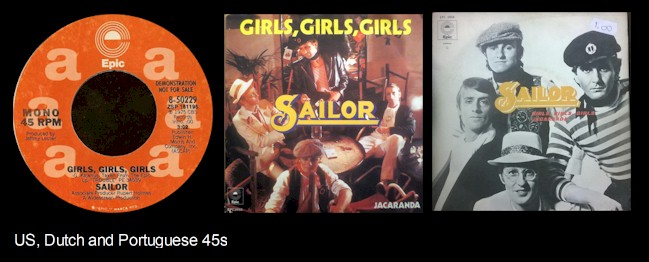
- 1976's "Girls Girls Girls" b/w '"Jacaranda" (Epic catalog number Epic EPC-3858)
There
are a bunch of lip-synching television appearances including this 1976
TopPop clip: Sailor
- Girls Girls Girls • TopPop As
you'd suspect from the song title, the gong and koto instrumentation gave
"Trouble In Hong King" a cartoon-styled oriental sheen.
Kajanus' vocals reminded me a little of Andrew Partridge and XTC, combined
with some Beach Boy harmonies. The track was another should've been
single, but relegated to the "B" side of their "The Old Nickelodeon Sound"
single. Taken from
a 1976 UK television special, YouTube has a live performance of the song: Sailor
- Trouble In Hong Kong 1976 - YouTube A
sweet, bouncy ballad "People In Love" sounded like something Harry
Nilsson might have recorded with an assist from 10cc with The Mamas and
Papas on background vocals. Hard to understand why it wasn't tapped as
a single. "Coconut"
was another track that
reminded me of a poppier version of XTC. Quirky, but still quite
commercial, though the jungle sound effects were unnecessary. The lone instrumental, powered by a harp "Jacaranda" sounded like something Simon and Garfunkel might have recorded with the Peruvian band Los Incas (think "El Condor Pasa"). Pretty and haunting melody. The track also appeared as the "B" side on their "Girls Girls Girls" single. The video and sound quality aren't great but YouTube has a clip of the band performing the song: Sailor - Jacaranda 1976
(side
2) I remember hearing this on Radio Caroline and thinking it was a new Roxy Music release. Musically it was way more pop, but the dry, slightly fey vocals sure sounded like Bryan Ferry taking a snide stab at pop music and the weird keyboard sounds had to be Brian Eno ... So much for my keen ear. "A Glass of Champagne" has to be Sailor's moment of glory. The track was released as a single throughout the world and seemingly charted everywhere (except the States). Powered by the Nickelodeon it was just a patented slice of mid-'70s goofiness perfect to let down year hair for a couple of minutes. Check out one of the "live" performance videos: Sailor - A Glass Of Champagne (1976) HD 0815007 .
-
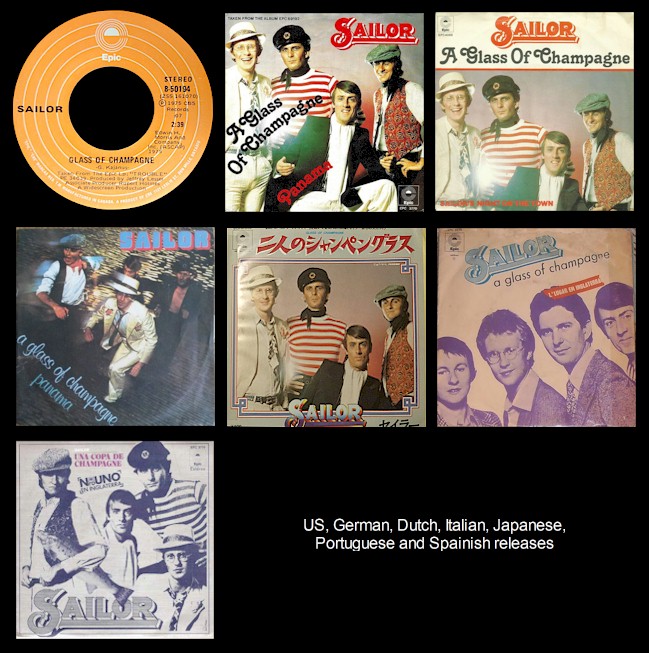
1975's "A Glass of Champagne" b/w "Panama" (Epic catalog number
8-50194) A
big, sappy ballad "My Kind of Girl" would not have sounded out of
place on a Charles Aznavour album. Not exactly my musical niche. I'm
guessing this video came from their UK television show: SAILOR
- My Kind of Girl Powered
by strumming mandolins, "Panama" was a breezy pop song that was so
goofy it made ABA and Boney M sound like hard rock acts. Hard to imagine
American audiences ever giving these guys a shot with lyrics like "...
Yi Yi Yi Panama, let's all buy a camera." The rack also appeared
as the "B" side to their "A Glass of Champagne "
single. The
intro street fight sound effects were funny, as was the whole song - imagine
Pete Townshend deciding to write a super short pop opera. Sailor showcasing they could record a sea shanty. As least you got to hear a clear Nickelodeon solo. Who knows why, but Epic tapped the song as a 45 in New Zealand. A couple of years later Presbyterian minister turned radio announcer Ewing Stevens chose the song as the theme song for his Radio Pacific consumer help-line show turning the 45 into a massive regional hit
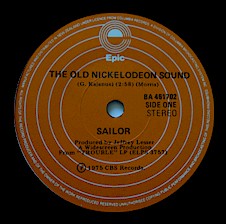
- 1975's "The Old Nickelodeon Sound" b/w "Trouble In Hong Kong" (Epic catalog number BA 461702)
The sound and video quality are poor, but YouTube has a live clip of the song at: Sailor - The Old Nickelodeon Sound (1976)
© Scott R. Blackerby December 2025
|
|
Genre: pop Rating: 2 stars ** Title: The Third Step Company: Epic Catalog: EPC
81637 Country/State: UK Grade (cover/record): VG / VG Comments: UK pressing; gatefold sleeve Available: 1 GEMM catalog ID: 5469 Price: $15.00
|
Full of shimmering pop melodies and slightly goofy lyrics, by all rights I should love 1976's "The Third Step". Try as I might I don't and I'm not quite sure why this one irritates me so much. Produced by Jeffrey Lesser, the ten George Kajanus penned tracks were all perfect for top-40 radio (I clearly recall hearing a couple of these on Radio Caroline). Part of the problem may be the fact songs like 'One Drink Too Many', 'Give Me La Samba', and 'Two Ladies On the Corner' were diabetes-inducing cute. Imagine a UK version of ABBA (with Benny an d Bjorn singing) that was more than willing to tap into different cultural genres in order to win a mid-1970s Europop contest and you'll get a feel for this stuff. Like ABBA or lots of the Chinn-Chapman catalog stuff , material like 'Cool Breeze' wasn't bad taken in small doses, but heard in one setting it was a bit much to take. At least to my ears it had the feel of product, rather than art. In the UK and most of Europe the album continued to band's commercial roll, spinning off a pair of hit singles:
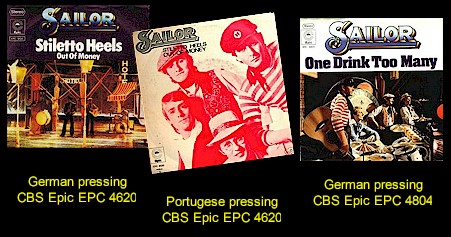
- 1976's 'Stiletto Heels' b/w 'Out of Money' (Epic catalog number EPC-4620) - 1977's 'One Drink Too Many' b/w 'Melancholy' (Epic catalog number SEPC-4804)
As far as I know this one never saw an American release.
inner sleeve photo
"The Third
Step" track listing: 1.) One Drink Too Many (Georg Kajanus) - 3:59 2.) Give Me La Samba (Georg Kajanus) - 3:17 3.) Cool Breeze (Georg Kajanus) - 2:21 4.) Two Ladies On the Corner (Georg Kajanus) - 2:45 5.) Dancing (Georg Kajanus) - 4:37
(side
2) 2.) Out of Money (Georg Kajanus) - 3:55 3.) Hanna (Georg Kajanus) - 3:16 4.) Quay Hotel (Georg Kajanus) - 4:05 5.) Melancholy (instrumental) (Georg Kajanus) - 2:35
Thanks to YouTube you can also see the band lip synching their way through a couple of studio performances:
http://www.youtube.com/watch?v=3IlF66fa-fY&feature=related 'One Drink Too Many'
http://www.youtube.com/watch?v=ch1Isf0bH0U&feature=related 'Stiletto Heels'
http://www.youtube.com/watch?v=OZkjcSPw6lw&feature=related 'Cool Breeze'
|
|
Genre: pop Rating: 3 stars *** Title: Dressed For Drowning Company: Caribou Catalog: C Country/State: UK Grade (cover/record): VG / VG Comments: promo stamp on back cover Available: 1 GEMM catalog ID: 5470 Price: $10.00
|
Teaming Sailor and producer James William Guercio made for one of the year's odder collaborations. Of course with the departure of longtime mainstay Georg Kajanus this was basically a new band (the husband and wife team of Gavin and Virginia David brought in as replacements, so why not try something radically different.
"Dressed
For Drowning" track listing: 1.) Danger On the Titanic (Philip Pickett) - 2.) Don''t Send Flowers (Philip Pickett) - 3.) Private Eyes (Philip Pickett) - 4.) Don't Look a Gift Horse (Philip Pickett) - 5.) Runaway (Philip Pickett) -
(side
2) 2.) Pearl Harbor (Henry Marsh - Philip Pickett) - 3.) Starlight (Philip Pickett) - 4,) Who Will Stop the Rain (John Fogerty) -
1980 A1.DANGER ON THE TITANIC B1.Hat Check Girl 7”: AUSL Caribou ES-575 1980 A1.DON’T SEND FLOWERS B1.Don’t Look a Gift Horse 7”: NET Caribou CRB-9077 1991 A1.LA CUMBIA (Radio Mix) B1.La Cumbia (Tropical Mix) 7”: GER RCA PB-44539 1992 1.LATINO LOVER 2.? 3.? CDS: GER RCA 10144 1992 1.IT TAKES TWO TO TANGO 2.Under the Moon 3.When My Ship Comes In CDS: GER RCA 11715 1994 HITS & HIGHLIGHTS (orig cd) GER RCA 18545 1997/8 THE VERY BEST OF SAILOR (orig cd) GER EMI 823152 2001.09.27 GREATEST & LATEST
|
Back to Bad Cat homepage/search
Back to BadCat payment information
The formation of what became possibly the most original sounding band of the '70s took place in 1973.
Georg Kajanus and Phil Pickett had known and admired each other's work for a number of years before collaborating on an album, Hi Ho Silver! Their subsequent decision to form a group found Grant Serpell, previously drummer and percussionist of cult jazz/rock fusion band Affinity, and Henry Marsh, previously keyboard player and guitarist with Gringo, making their first demo recording with Georg and Phil in a small studio in North London.
The original line-up of the band at this point was 2 guitars, bass and drums and the music, although original in its vocal approach, was instrumentally very much in the vein of 'Harmony Rock' music of that time. One historic day in his music room, where he experimented and wrote all his songs, Georg played to the others, by way of entertainment, a demo tape of a musical he was planning to write.
The strange and unusual sound of harmoniums, mandolins, glockenspiels, hand-bass drums and tack pianos filled the room. The song was "Sailor's Night On The Town", and Grant, rising from his seat in ecstasy, exclaimed that this was the sound they had been looking for. "It contained a pathos that I'd never heard in pop music before; we had all come from the '60s where there were many bands all basically doing the same thing; here was something for me to be involved in that was totally unique."
From that point on, as more songs in the style of "Sailor's Night" flowed from Georg's twelve-string and pen, a whole style of playing started to develop between the four members. Bass guitars were replaced by enormous synthesizer bass sounds, standard keyboard styles gave way to street-organs, and drum and percussion approaches of a totally unique style were originated. In fact, a whole new attitude to playing and presentation appeared to be necessary in order to make the music work
In due course, CBS Records came to audition a new act called SAILOR. Rather than witnessing the customary long-haired rock bands prevalent at that time, they found themselves in a small room with four short haired young men who played a multitude of unlikely instruments and sang songs about red-light quarters, sleazy underworld characters, and romance of an altogether quirky nature.
The CBS reaction was immediate and the first SAILOR album was recorded in Spring 1974. Georg recalls the making of "SAILOR": "Production-wise it was all down to emphasising all the colours I was feeling and seeing within the instrumentation and music, and not really paying too much attention to individual sounds; just having fun making things sound atmospheric."
Their first single "Traffic Jam" was probably Georg's last composition written before the SAILOR concept music began, but was always considered to be the perfect introductory single for the band and an excellent opener to the album.
By the time the album was finished the complexity of the group sound created a new challenge for SAILOR: How were four musicians going to successfully deliver the sound of about ten instruments on stage without increasing their line-up? (Bear in mind that this was 1974, long before the advent of computer keyboards which can play any sound at the touch of a button.)
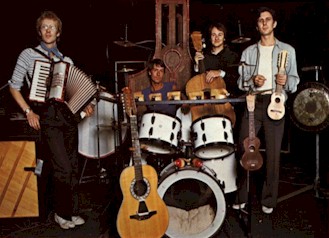
Within a very short time, in fact possibly as little as a month after the final mix of the SAILOR album, Georg had come up with the solution: a custom-designed all-purpose machine, the constituents of which were two upright pianos, two synthesizers, mini organs and glockenspiels all mechanically linked and contained within a wooden frame also designed by Georg.
Construction work took place above a pub,
appropriately in one of the seedier parts of London.
Henry: "I remember standing next to Georg handing him hammers, nails, glue,
sandwiches and anything else required, as he set about his creation like a man
pssessed! After the final staining of the wood which made it resemble some
strange piece of antique furniture, I recall standing back, looking at it and
thinking: 'He actually expects us to play the bloody thing?'"
The basic keyboards were back to back, enabling Phil and Henry to face each other when playing, and also to talk to each other when bored. Phil played what was referred to as the bass side, Henry the treble side, and so the Nickelodeon was born.
Anyone seeing early film footage or photos of SAILOR from that time would be forgiven for thinking that this was some strange combo from the 1940s. Grant's drum and percussion console resembled something from the Edmundo Ros Orchestra. The overall theatrical setting consisted of a harbour town/cafe/street lamp which cast a red glow over the players, plus an amazing collection of Latin American instruments procured by Georg on one of his many trips to Mexico. All these placed the audience in a unique and nostalgic world.
SAILOR's first performance was a live In Concert for BBC Television in September 1974. Although there is no known copy or recording of this programme, it is generally remembered by the band as being an altogether terrifying experience. Never having played to an audience before, to find yourself in front of five or six TV cameras capturing your every movement for millions of people to witness live was an unforgettable experience.
Georg: "I've never been so terrified in my
whole life. It's the sort of thing sane people wouldn't do!"
Henry: "I remember our facial expressions that night were mouths that
smiled and eyes that screamed!"
Phil: "My heartbeat was so loud, I thought it was being picked up by the
microphone!"
Grant: "I was a drummer who found himself playing the main Nickelodeon part
in "A Sailor's Night On The Town" on live TV, knowing that if I got
lost during the playing of the part I'd never find my way back!"
The natural shyness of this first night, coupled with the enormous sound and energy that came across in the music and instrumentation, created a tidal wave of excitement throughout the media in England.
SAILOR found themselves representing CBS at conventions in Los Angeles, Paris and England as the new band worth watching, whilst established artists invited them to be tour support for them. Kiki Dee's tour was quickly followed by a wonderful alliance and friendship with Steve Harley and Cockney Rebel. Steve, a new-found SAILOR fanatic (he saw that first TV In Concert) was at that time at the height of his success with a number one hit in England, 'Come Up And See Me, Make Me Smile', and insisted that SAILOR be the other act on his forthcoming tour.
Whereas the Kiki Dee tour had been valuable experience on warming up an audience for the main act, the Harley tour was perfect in every respect. Not only did both acts appreciate each other's music, but also the Harley fans themselves took SAILOR to their hearts, finding in the SAILOR music a similar danger and excitement to that of Cockney Rebel.
In February 1975 the "SAILOR" album reached Gold status in Holland, much to the delight of the Dutch record company and the slight embarrassment of the UK company.
It was of course understandable that the music of SAILOR should be so well received by the Dutch, the first album containing a song called "The Girls Of Amsterdam" and the Nickelodeon sounding as if it belonged to the streets of Amsterdam; but it should also be pointed out that Holland was extensively toured by the band, as many Dutch fans of the '70s will remember, when they headlined at the Concert Gebouw Amsterdam and performed a memorable set at the Pink Pop Festival, a venue usually associated with heavy rock artists, where they received an ovation from over a hundred thousand people.
This success in Holland gave the band enormous confidence and impetus, but the emphasis now seemed to be on creating the same degree of impact in their home country - in conquering the UK.
By that summer, following various small headlining tours of the UK, Scandinavia and Holland, SAILOR were ready to take to the studio again, but by now they had developed into a formidable live act and this energy needed to be captured on tape by a sympathetic and imaginative production team.
The first meeting with New York's Jeffrey Lesser and Rupert Holmes soon removed any doubt that this would be an excellent working relationship. In spite of the fact that two different cultural worlds were meeting, the chemistry created between the two Americans and the four Europeans gave birth to the legendary Trouble album, still considered to be SAILOR's most successful work to date.
However, at the time of recording there was concern over finding that elusive 'hit' single which would pave the way for big album success. Phil well remembers the morning that Georg arrived at the studio with a cassette containing the backing track idea to a song called "A Glass Of Champagne": "We were in the middle of recording something like "Jacaranda", which involved a harp and various other unusual ingredients. We took one listen to "Champagne" and knew it was the HIT." Of all the songs in the Trouble album, "A Glass Of Champagne" probably took the least time to record, instantly capturing the power of Georg's original demo. "Girls, Girls, Girls", a song that had been performed live by the group for a few months before recording, became the perfect choice as the opener to the album.
At the time nobody realized that "Girls, Girls, Girls" would become virtually the anthem for the band and is, coupled with "Champagne", the highest selling SAILOR single.
The completion of the "Trouble" album
also gave birth to a change in the visual appearance of the band. Up to that
point SAILOR had dressed, inevitably, as SAILORs! The attitude to the image had
always been rooted in Theatre rather than Rock, the members of the group
portraying the four SAILORs out on the town in a red-light district near you(!),
but this uniformity was frowned on by many observers in the media as giving
SAILOR altogether too safe and lightweight an image.
"Not that lightweight," recalls Phil. "Once we were doing a photo
session in the red-light quarter of Amsterdam and were mistaken for the real
thing by some drunken merchant seamen. I think after a few drinks we nearly
ended up on a ship bound for Rumania!"
The new 'look' - see the Trouble album reference
- established Georg as a recognizable lead singer and figurehead in SAILOR. The
more decadent 'dockside' appearance seemed to belong even more to the imagery of
the music. The recognizable anchor on his cheek, however, created one
unfortunate complication.
Georg: "I read in a paper shortly after our first TV appearance in this
image that two girl fans had real tattoos applied to their faces, not knowing it
was just stage make up!"
With "A Glass Of Champagne" reaching
the number one spot in the UK over the Christmas period of 1975, it appeared to
many observers that this was an overnight success story, this being the first
SAILOR song to make a noticeable impact in the UK. Their first major headlining
tour followed to sensational live reviews in all the national and music journals
coupled with fan mania that the band were quite unprepared for.
Grant: "We regularly found ourselves mobbed by hundreds of fans before and
after concerts, with only one faithful but panic-stricken 'roadie' to keep them
at bay."
Phil: "After one gig, on one of the few occasions Ann (Phil's wife) came to
see us perform, a jealous fan bit her on the arm!"
It was during these tours that Henry began to
emerge as a humorist and somewhat lunatic raconteur on stage. This element
actually created a memorable challenge to him on one occasion.
Henry: "The problem was this: all our machinery on stage was so unusual
that if it ever broke down during a concert, there was only one person who could
fix it. Yes, you've guessed it... Georg! So, when half way through a performance
in Plymouth the nickelodeon started squealing like a strangled pig, Georg, Phil
and Grant left the stage with the offending keyboard, to Georg's immortal words:
'Ladies and Gentlemen, sorry about this, but we leave you in the capable hands
of Henry Marsh!' I was left with an accordion, an audience of two thousand
people and a rather average repertoire of bad jokes and old English Music Hall
songs until the others returned."
"Girls, Girls, Girls" was released in the spring of that year and proved to have the same impact as "A Glass Of Champagne" and the "Trouble" album, working its way towards Gold status all over Europe and in Australia. It seemed as if SAILOR were on a roll and nothing could go wrong. (Cue music of an ominous nature...)
The decision to send SAILOR on their first
American tour at such an early stage in their European success was the result of
a number of things. Their manager at the time, Robert Wace, who had been a
considerable influence and source of guidance, saw the USA as being the next
step for any successful UK rock act. As ex-manager of The Kinks and now managing
SAILOR under the umbrella of the Pink Floyd Organisation, he was no stranger to
the gruelling tours necessary to break artists in the States.
Although SAILOR's second live performance ever had actually been in Los Angeles
at the CBS convention, where they had record executives on their feet screaming
for more, the tour which was now mapped out for the band and which they
undertook to honour, was appallingly planned without any consideration for the
band's style of music or the compatibility they might or might not have with the
headlining artists that they supported.
Grant: "The feeling was one of helplessness. We'd play to an audience of 60
people, when across the road Steve Miller had sold out in the main venue of that
city. We knew we should be back in Europe where we could fill halls and play to
fans who had not yet been able to see the live show."
One minute they would find themselves playing to a hard core Country &
Western audience in San Diego, impatiently awaiting Charlie Daniels, next a rock
audience in Atlanta, even at one point an all-black soul audience in
Philadelphia who very politely rose from their seats and left after the first
few bars of "Let's Go To Town", the opening song of the evening. Let's
Go To Town... and they did!
Georg: "The feeling for me was just to get the hell out of there and get
back home, but we had to stay and do our best."
Phil: "Being booed on stage by a sea of Stetsons before you've even played
a note doesn't exactly warm you to an audience."
It is said of American tours that they either
make or break a band depending on how well the artists in question are received.
This fortunately wasn't the case with SAILOR, who had always recognized their
strong European roots, and in spite of bad choices of venue they still managed
to create a cult following in the more intimate club environments that came
their way.
Although a degree of depression sank in, the humour of the band saw them through
some of the more unfortunate gigs.
Henry: "Phil offered one unfriendly audience a recitation of our new double
album rather than giving them just one more song, and on another occasion Georg
and I got such a hysterical fit of giggles during "Josephine Baker"
(not the best cultural choice for the American public) that he just stopped
singing and I fell off the stage!"
In spite of these tales of woe, there were some creative moments. Georg managed to write "Quay Hotel", later to become a favourite track of the third SAILOR album "The Third Step". This song was inspired by an extraordinary person he came across in the Beverly Rodeo Hotel.
There was also some very good news filtering across from Europe. SAILOR were now a household name in Germany, a country they had long wished to tour, with talk of a TV special featuring the band and calls for numerous other appearances.
After six weeks of exhaustive travel and performances, the band were on their way home, and the flight from New York to London was nothing short of a celebration.
TRAFFIC JAM/Josephine Baker
A GLASS OF CHAMPAGNE/Panama
Epic 8-50194 (1975)
GIRLS GIRLS GIRLS/Jacaranda
Epic 8-50229 (1975)
RUNAWAY/Put Your Mouth Where The Money Is
Epic 8-50557 (1978)
Their only hit single in America (to date!)
DANGER ON THE TITANIC (edit)/Hat Check Girl
Caribou 02598 (1980)
RUNAWAY (new version)/?
Caribou 9035
 rky
and about as far from "cool" as a musician could get.
Imagine a less quirky version of Sparks, or Roxy Music. And speaking
of Roxy, I remember reading a
Ken Tucker review of this album in Rolling Stone (back when it
mattered). As I recall Tucker drew some comparisons to a second rate
Bryan Ferry and Roxy Music. As a Roxy fan I remember being appalled by
the comparison, but having listened to the LP for the first time in a
decade, I can see where he was coming from. Kajanus'
clipped delivery
really did occasionally recall Ferry (check out ""), and the
Nickelodeon's odd sound wasn't that far off from something Brian Eno could
have come up with had he been interested in sales success. Be sure to check out
their moment of commercial glory - "A Glass Of Champagne".
I've always heard this Sailor album as kind of a weird travelogue soundtrack
- imagine Kajanus sitting in his living room spinning a large globe,
randomly picking spots on the map and writing songs borrowing the local
musical genres: Southeast Asia - "Trouble In Hong Kong"; the
Caribbean - "Coconut" and Latin America -
"Panama". The results were cute, but like a joke, got old
after you heard it a couple of times. Plus, most image conscious under
thirty listeners (myself included) were probably worried about admitting
they liked the band. Besides, this stuff was just too cutesy for most Americans.
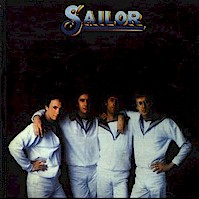
Hard to picture anyone buying an album featuring a frontman wearing a sailor
outfit complete with scarf and anchor tattoo on his face.
rky
and about as far from "cool" as a musician could get.
Imagine a less quirky version of Sparks, or Roxy Music. And speaking
of Roxy, I remember reading a
Ken Tucker review of this album in Rolling Stone (back when it
mattered). As I recall Tucker drew some comparisons to a second rate
Bryan Ferry and Roxy Music. As a Roxy fan I remember being appalled by
the comparison, but having listened to the LP for the first time in a
decade, I can see where he was coming from. Kajanus'
clipped delivery
really did occasionally recall Ferry (check out ""), and the
Nickelodeon's odd sound wasn't that far off from something Brian Eno could
have come up with had he been interested in sales success. Be sure to check out
their moment of commercial glory - "A Glass Of Champagne".
I've always heard this Sailor album as kind of a weird travelogue soundtrack
- imagine Kajanus sitting in his living room spinning a large globe,
randomly picking spots on the map and writing songs borrowing the local
musical genres: Southeast Asia - "Trouble In Hong Kong"; the
Caribbean - "Coconut" and Latin America -
"Panama". The results were cute, but like a joke, got old
after you heard it a couple of times. Plus, most image conscious under
thirty listeners (myself included) were probably worried about admitting
they liked the band. Besides, this stuff was just too cutesy for most Americans.
Hard to picture anyone buying an album featuring a frontman wearing a sailor
outfit complete with scarf and anchor tattoo on his face.